General


For years, managed security services have been built around the systems surrounding identity: endpoints, email, networks, backups, and cloud applications.
But every one of those services ultimately relies on one core principle:
Who is allowed in, and under what conditions?
For many small businesses, the answer is still determined by a username, password, and some form of MFA. That may establish who the user claims to be, but it does not always account for the device they are using, where they are connecting from, or whether the circumstances surrounding the login make sense.
MSPs already understand this gap. The harder question is how to close it for clients that need stronger access control but may not have the budget, resources, or operational need for a broad enterprise identity platform.
HENNGE Identity gives MSPs a more focused path. It brings conditional access, device trust, secure authentication, and data leakage controls for unmanaged devices into a single identity solution that can be packaged as an ongoing service.
That gives MSPs room to do more than resell another security product. They can build a clear per-user offer around HENNGE Identity, add policy management, device administration, access reviews, and other services, then grow the package as the client’s needs become more complex.
Because the underlying cost remains accessible for smaller organizations, the service can create recurring value for the MSP without putting stronger identity security out of reach for the client. It becomes a repeatable offer that can be introduced early, standardized across accounts, and expanded over time.

Why Small Businesses Are Still Underserved by Identity Security
MSPs managing small businesses are often expected to choose between two imperfect options.
They can continue with the identity controls already included in the existing environment, even when those controls no longer provide enough protection. Or they can move to a more advanced identity solution, increasing the client’s cost while giving the MSP little room to build a clear, profitable service around the upgrade.
The gap between those options is where many SMBs remain exposed.
Their environments might be smaller, but they are rarely simple. Employees work from multiple locations. Personal and company-owned devices often exist side by side. Contractors, who come and go, could need temporary access. Business-critical data lives across Microsoft 365 and other cloud applications, while the company itself has no internal security team overseeing how access is granted.
Entra ID Free provides an important starting point by centralizing identities and supporting authentication across Microsoft services. What it does not provide is the deeper policy control needed to evaluate the context around each login.
That distinction matters.
Confirming that a user knows the correct password and can complete OTP is only one part of the access decision. An MSP may also need to know whether the device is approved, whether the connection comes from an expected location, whether the request falls within permitted hours, or whether the application requires a higher level of trust.
Without those controls, access remains broader than many businesses realize.
For some clients, the right answer is a more advanced Microsoft license. For others, the cost and breadth of that upgrade might be difficult to justify when the immediate need is stronger identity control.
HENNGE Identity fills that gap by adding a focused identity layer to the environment the client already uses. MSPs can introduce stronger access policies at a level the business can support today, then expand the service as its users, applications, and security requirements grow.

Why Identity Security Works Naturally as a Managed Service
Identity security is not something a business configures once and leaves untouched. Access needs change as employees join, leave, move into new roles, adopt new devices, and begin using new applications. A policy that made sense when a company had ten employees may no longer be appropriate once it has multiple teams, remote contractors, and more sensitive systems in use.
That constant change is what makes identity well suited to a managed service. The value does not end when HENNGE Identity is deployed. It continues through ongoing identity governance: maintaining policies, managing trusted devices, reviewing access activity, and adjusting controls as the client’s environment evolves.
For smaller businesses, that responsibility can be difficult to manage internally. They may not have a dedicated security team, and identity decisions are often handled reactively by whoever manages Microsoft 365 or general IT. An MSP can bring more structure to that process by maintaining a clear access model across the environment instead of stepping in only when a user is locked out or an employee leaves.
That ongoing work may include:
updating policies when roles change
issuing and revoking device certificates
reviewing authentication logs
managing onboarding and offboarding
adjusting controls for new applications
checking that privileged users still have the right level of access
This turns identity from a collection of settings into an ongoing security function. It also gives the MSP a service that can be repeated across clients without becoming rigid. The same core approach can be applied in multiple environments, while individual policies still reflect how each business operates.
One client may need stricter controls around finance applications. Another may rely more heavily on personal devices. A third may need temporary access for contractors or outside partners. The framework stays consistent, but the service adapts to the client.
That balance matters because a managed service has to be standardized enough to deliver efficiently while remaining flexible enough to solve a real problem. HENNGE Identity gives MSPs that foundation by bringing the most important access controls into one place and making them practical to manage over time.
The MSP is not simply maintaining a login tool. It is taking responsibility for how access is governed as the business changes.
What HENNGE Identity Adds Beyond Entra ID Free
For that service to create lasting value, the underlying platform has to give the MSP meaningful control over how access is evaluated and enforced.
Entra ID Free gives small businesses a useful identity foundation. It centralizes user accounts, supports single sign-on, and helps organizations move away from managing credentials application by application. For many companies, that is an important first step.
The gap appears when the business needs more than authentication.
Knowing that a user has entered the correct password and completed MFA does not always tell the MSP whether the access request should be trusted. If the device is unmanaged. If the connection came from an unexpected location. If the request happens outside normal working hours or involves an application that requires a higher level of control.
HENNGE Identity gives MSPs a way to account for that context and turn it into policy.
Conditional access that reflects how the client operates
HENNGE Identity allows access decisions to be based on conditions such as approved IP ranges, device trust, day and time, user or group, and custom attributes. This gives MSPs more flexibility than applying the same authentication requirement to every user and every application.
A finance team, for example, will likely need stricter access conditions than a general employee group. Contractors also require different policies than permanent staff. Certain applications may only be available from trusted devices or approved locations.
These policies allow the MSP to translate the client’s working environment into enforceable rules. Instead of asking only whether the credentials are valid, the system can also consider whether the circumstances surrounding the login make sense.
A more controlled authentication experience
HENNGE Secure Login gives MSPs more control over how users enter the environment.
Rather than relying entirely on the standard Microsoft sign-in experience, organizations can use a distinct login flow that is easier to standardize across the applications protected by HENNGE Identity. This can help reduce the familiarity that phishing attempts often exploit and gives users a clearer, more consistent authentication experience.
For the MSP, Secure Login also becomes part of the service being managed. Authentication methods, policy requirements, permitted login attempts, lockout duration, and user access can all be configured around the client’s needs rather than left as a default experience that looks the same across every environment.
Device trust that can be enforced
Device visibility and device trust are not the same thing.
HENNGE Identity uses device certificates to help MSPs identify approved endpoints and make that trust part of the access decision. A policy can require a valid certificate before a user is allowed to reach a sensitive application, or combine device trust with another authentication method for stronger protection.
This gives MSPs a practical way to manage questions that are common in smaller environments:
which devices should be allowed to access company systems
how personal devices should be handled
what happens when a device is lost or replaced
when access should require both OTP and a trusted endpoint
Certificates can be issued, reviewed, and revoked as the client’s device environment changes. That makes device trust an ongoing control rather than a one-time registration task.
Controlled access from unmanaged devices
Small businesses cannot always eliminate access from personal or unmanaged devices. Owners travel, contractors use their own hardware, and employees may occasionally need to work outside the usual environment.
HENNGE Secure Browser gives MSPs a middle ground between blocking access entirely and treating every device as fully trusted.
Users can reach approved applications through a controlled browser session, while the MSP applies restrictions around actions such as downloads, clipboard use, and screen capture. The client keeps the flexibility it needs, but access is handled with more care than a standard browser session would allow.
Taken together, these capabilities give MSPs more than a collection of features. They provide a set of controls that can be reviewed, adjusted, and managed over time.
That is what makes HENNGE Identity suitable as a managed service. The MSP is not only helping users sign in. It is maintaining the conditions that determine when access should be allowed, challenged, restricted, or denied.
Why the Opportunity Is Growing Now
The gap between basic authentication and managed access control is becoming harder for small businesses to ignore.
Cyber insurance applications increasingly ask organizations to show how MFA, privileged access, and other identity controls are applied, rather than simply confirming that a security tool exists. Compliance requirements across frameworks such as HIPAA, CMMC, SOC 2, and PCI are also putting more pressure on businesses to document who can access sensitive systems and how that access is governed.
At the same time, changes across the Microsoft ecosystem continue to connect more security and compliance capabilities to paid licensing requirements. For MSPs serving clients on Entra ID Free or lower Microsoft 365 tiers, waiting often means allowing the gap between the client’s current controls and external expectations to grow wider.
A managed identity service gives MSPs a practical way to address that pressure now. It creates a clear security improvement for the client and a repeatable offer the MSP can begin delivering before the account is ready for a broader enterprise stack.
This creates urgency without turning the article into fear-based content.
The Economics of a Repeatable Identity Service
A managed service has to work commercially as well as technically. The client needs to see a clear security benefit at a price that feels realistic, while the MSP needs enough margin to support delivery, ongoing management, and account growth.
That is where HENNGE Identity becomes especially compelling.
HENNGE Identity’s partner pricing gives MSPs room to create a straightforward identity package without pushing the client toward enterprise-level costs.
Consider an MSP with a partner cost of $3.50 per user per month that packages the service at $10 per user*. Before accounting for labor and other delivery expenses, that leaves $6.50 in gross profit per seat, or a gross margin of 65%.
For a 25-user client, that represents $1,950 in annual recurring gross profit. Across ten similar clients, the same offer could generate $19,500 annually. At 625 managed users, the annual gross profit reaches $48,750, before accounting for the additional services the MSP may include around the platform.
*Pricing is illustrative and may vary based on partner agreements, service scope, and other delivery costs.
The value is not only in the software margin. HENNGE Identity gives the MSP room to build services around the platform, whether that means policy management, access reviews, device certificate administration, onboarding and offboarding support, or regular reporting.
That flexibility allows the MSP to keep the entry package simple while still creating higher-value tiers for clients that need more support. A basic offer might focus on deployment and policy maintenance, while a more advanced package could include scheduled access reviews, compliance support, or tighter controls around higher-risk users and applications.
This makes the service easier to sell to smaller businesses because the offer can be matched to what they actually need today. The client is not being asked to adopt a broad security platform all at once. They are paying for a focused identity service with a clear monthly cost and room to expand over time.
For the MSP, that creates a healthier long-term model. The account begins with an affordable service, but the relationship does not stay small. More users, more applications, and more advanced security needs all create natural opportunities to grow the service alongside the client.
What a Managed Identity Package Can Include
Once the pricing works, the next question is what the client is actually buying.
The strongest version of this offer is not a software license with a few support hours attached. It is a defined service with a clear scope, a predictable monthly cost, and an outcome the client can understand: stronger control over who can access the business, from which devices, and under what conditions.
A core package could include the initial HENNGE Identity deployment, policy configuration, device certificate setup, user and group management, onboarding and offboarding support, and periodic reviews of authentication activity. For many smaller businesses, that is already a meaningful step up from simply relying on the identity settings included with their existing cloud environment.
The service can then be shaped around the way the MSP prefers to work. One provider can include quarterly policy reviews as standard. Another could bundle identity with Microsoft 365 administration, endpoint protection, or cyber insurance readiness. A third may create separate tiers based on how much ongoing oversight the client needs.
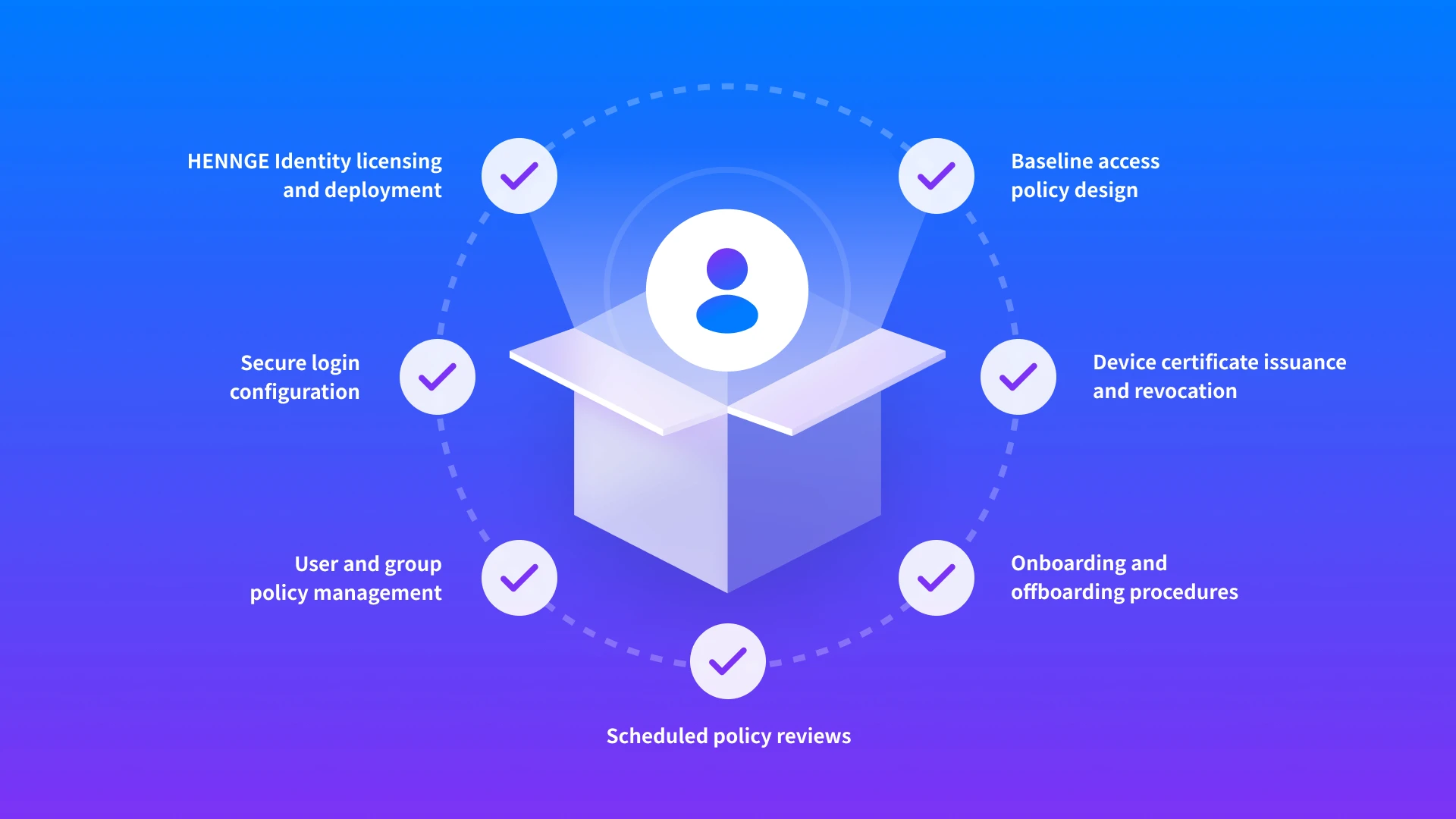
For example, an entry-level package might cover:
HENNGE Identity licensing and deployment
baseline access policy design
Secure Login configuration
device certificate issuance and revocation
user and group policy management
onboarding and offboarding procedures
scheduled policy reviews
A higher-touch tier could add regular log reviews, privileged-account checks, compliance documentation, or faster support for user and device changes. The underlying product remains the same, but the service layer becomes more involved as the client’s needs grow.
This flexibility is important because small businesses do not all mature at the same pace. While one client only needs a stronger access baseline today, another might already be dealing with audit requirements, remote contractors, or sensitive applications that call for tighter controls.
HENNGE Identity gives MSPs a stable foundation for both. The core service stays recognizable and repeatable, while the surrounding package can expand without forcing the client to replace the solution they started with.
That is what makes the offer easier to scale. MSPs can build one clear identity service, refine the delivery process, and apply it across multiple accounts without turning every deployment into a custom project.

Why a Microsoft Upgrade Is Not Always the Best Fit
For some clients, moving to Microsoft Business Premium or adding Entra ID P1 or P2 will make sense. Those options offer a broader set of identity and security capabilities, especially for organizations already investing heavily in the Microsoft ecosystem.
The question is whether every small business needs that breadth.
SMBs are trying to solve a focused problem: stronger control over login conditions, better device trust, safer access from unmanaged endpoints, or a more consistent authentication experience. A larger Microsoft upgrade could address those needs, but it can also introduce additional cost and complexity that the client is not prepared to use or manage.
That can make the recommendation harder to justify. The MSP finds itself explaining an entire licensing change when the client is primarily concerned with a smaller set of access risks. Even when the technical case is strong, the business case can feel oversized for the problem at hand.
HENNGE Identity offers a more targeted path. MSPs can strengthen the client’s identity layer without asking the business to replace its current Microsoft 365 plan or adopt a wider collection of features before it needs them. The service stays focused on access control, authentication, device trust, and the policies surrounding them.
The economics are also different. With a Microsoft licensing upgrade, a larger share of the client’s budget goes directly toward the license itself. There could still be room for implementation and management fees, but the MSP has less flexibility to shape the product cost into a service with its own recurring margin.
HENNGE Identity leaves more room for the MSP to define the offer. The partner can set the client-facing price, decide what level of management to include, and build the package around the outcomes most relevant to that business. That means a simple identity baseline for one client and a more hands-on service for another.
This is not an argument against Microsoft’s paid identity products. It is an argument for matching the solution to the client.
Some businesses need a broad platform. Others need a focused identity service that closes the most immediate gaps without forcing a larger change across the environment. HENNGE Identity gives MSPs a way to serve that second group without treating them as temporary accounts that must eventually be moved into an enterprise model.
By filling the space between Entra ID Free and a broader Microsoft upgrade, HENNGE Identity gives MSPs another option: one that is easier to package, easier to explain, and often better aligned with the needs of smaller clients.
How the Service Grows With the Client
The value of a managed identity service does not end with the first deployment. In many cases, that is where the longer-term opportunity begins.
A small business starts with a limited number of users, a handful of cloud applications, and a relatively simple access model. At that stage, the MSP could focus on establishing stronger login controls, trusted-device requirements, and a consistent process for onboarding and offboarding.
As the business grows, the identity environment becomes more demanding. New teams are added. More applications enter the stack. Contractors and outside partners need access. Certain roles begin handling more sensitive data, while compliance or insurance requirements introduce new expectations around how access is controlled and documented.
Because HENNGE Identity is already part of the environment, the MSP does not need to rebuild the service each time those needs change. It can expand the existing model by adding users, refining policies, introducing stronger conditions for higher-risk applications, or increasing the level of review and support included in the package.
That creates several natural growth paths within the same account:
additional seats as the client hires
new applications brought under single sign-on
stricter policies for administrators and sensitive teams
expanded device certificate management
more frequent access and policy reviews
compliance support and reporting
adjacent services such as endpoint protection or cloud security
This approach is especially valuable for smaller clients because it does not require them to buy for the company they might become several years from now. They can begin with a service that fits their current size and add more protection as the business becomes more complex.
For the MSP, that turns account growth into something more predictable. Revenue can increase with seat count, but it can also grow through deeper service involvement. A client that begins with basic identity management may later need more structured access reviews, privileged-user controls, policy documentation, or support across a wider application environment.
The relationship grows because the service remains relevant at each stage. HENNGE Identity gives the MSP a foundation that can support the client early, adapt as requirements change, and make room for additional services without forcing a complete change in direction.
That is the larger opportunity behind the model. MSPs can win smaller accounts with a service those businesses can afford, then continue building value as those clients grow.
A Managed Service That Works for Both Sides
HENNGE Identity gives smaller businesses stronger access control without requiring them to adopt a broader security platform than they currently need. For MSPs, it creates a defined service that can be priced per user, standardized across similar accounts, and expanded through additional management and security services.
That makes the space between Entra ID Free and a larger Microsoft upgrade more than a product gap. It becomes an opportunity to support smaller clients earlier, build recurring value around identity, and grow the relationship as their needs become more complex.